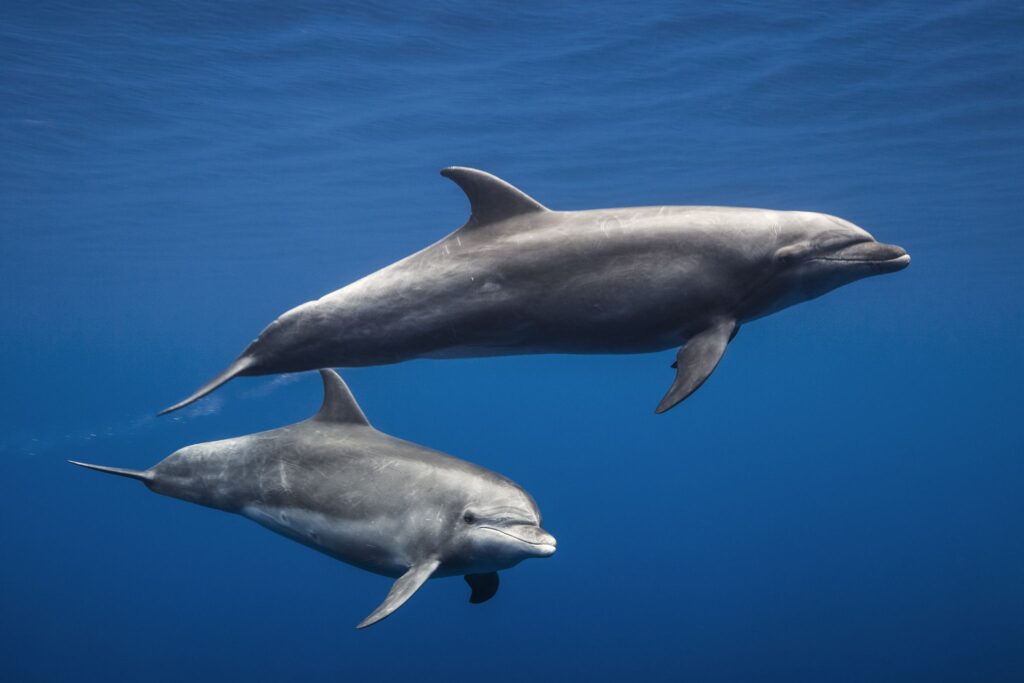
The Bottlenose Dolphin: Protagonist in Tenerife Whale Watching Trips
By: Marina Tortosa (@marinatortosa27 / @aguitasubmarina)
Anyone who has been lucky enough to enjoy a whale watching trip off the island of Tenerife will undoubtedly be familiar with one of the most commonly sighted species on these maritime excursions, alongside the short-finned pilot whales: the bottlenose dolphin. These truly exceptional, friendly and endlessly curious animals, which inhabit the warm and temperate seas across the globe, have found a natural refuge in the Canary Islands.
The bottlenose dolphin (Tursiops truncatus) is a species of toothed cetacean belonging to the family Delphinidae — the largest of all true dolphins (excluding orcas and pilot whales): it can reach up to 4 metres in length and weigh half a tonne, although individuals from the resident populations in the Canary Islands are somewhat smaller. It is a very frequent visitor on Biosean boat trips (@biosean_), loves to show off in front of visitors and enjoys riding the wake left by our boat.
Would you like to learn a little more about this charismatic animal? Read on — we think you’ll enjoy it!
An Iconic Species
Bottlenose dolphins are usually found swimming or hunting about 2 to 3 miles from the coast, along the routes we typically follow. Groups of up to 30 or more individuals can be spotted — including females with calves! On occasion, they travel in mixed groups alongside Atlantic spotted dolphins (Stenella frontalis) and common dolphins (Delphinus delphis). At the surface, accompanying the pod during hunting, we may also spot Cory’s shearwaters and yellow-legged gulls.
The bottlenose dolphin is probably at the top of the list of the best-known cetacean species, due to its appearances in films and its unwilling presence in countless dolphinariums. However, the number of wild individuals has declined as a result of habitat degradation, water pollution and interactions with human activities such as fishing. Furthermore, whale watching trips that fail to comply with established sighting regulations can affect dolphin behaviour and increase their stress levels, raising the likelihood of collisions.
How Can I Tell the Bottlenose Dolphin Apart from Other Dolphins?
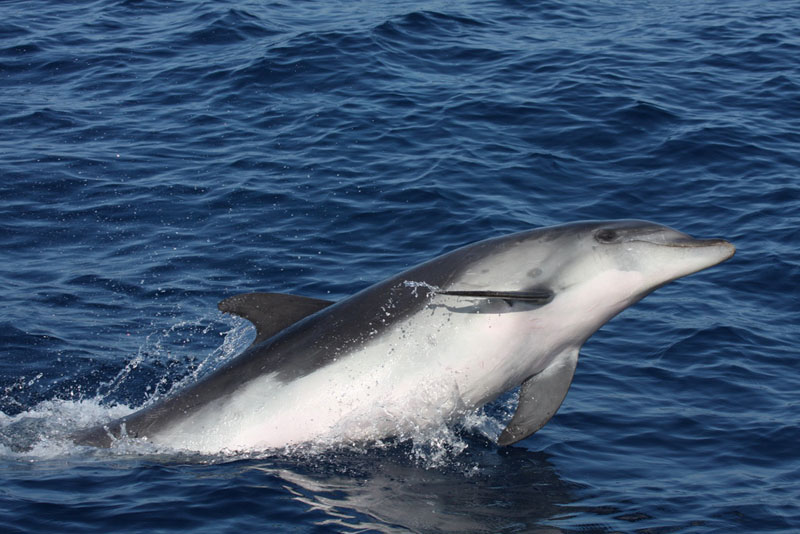
When you’re out on the boat and a group of dolphins comes over to investigate, pay attention to a few details that will help you identify the bottlenose dolphin among all dolphin species. In addition to its distinctive beak — as its name suggests — when swimming at the surface we can see the dark grey colour of its back. If we’re lucky and it comes relatively close to the boat, we’ll be able to appreciate the lighter grey on its sides and, on its underside, an almost white colouration.
If you’re not sure about the identification, you can always ask any member of the Biosean team on board — we’ll be happy to help!
Do you think this colour pattern is coincidental? Not at all!
This colour pattern acts as marine camouflage against both its predators — sharks — and its prey. When looking up from below, there will be no contrast between the light entering the water and the animal’s pale belly. Conversely, when the dolphin is near the surface, its dark grey back will blend with the colour of the seabed below. Other marine animals, such as sea turtles, use this same camouflage strategy.
It can be quite difficult to identify specific individuals, since dolphins — like most cetaceans — spend the majority of their time underwater and only reveal a small portion of their body when they surface. For this reason, photo-identification — which involves photographing the markings and scars on dorsal fins — is a very useful tool for determining which individual is being observed. The Tonina Association, a group dedicated to research, outreach and conservation of the marine environment with which Biosean collaborates, maintains a PhotoID catalogue of bottlenose dolphins, short-finned pilot whales, beaked whales and fin whales sighted around Tenerife — a true gem of marine conservation!
Echolocation: The Superpower of Some Cetaceans
If someone asked us what a bat, a dolphin and a sperm whale have in common, the answer would be clear: all three are mammals capable of echolocation. But what exactly is echolocation?
Bottlenose dolphins, like all other dolphins, possess this fascinating and ancient system which functions as a prey detector, self-defence mechanism (to avoid becoming part of another predator’s menu…) and an excellent navigation tool in their vast habitat: the ocean.
Echolocation works in a very simple way: the animal emits a sound that bounces back upon hitting an obstacle.
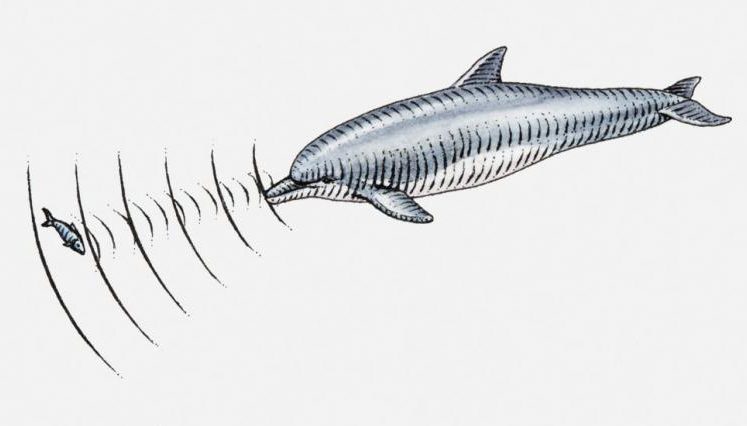
The bouncing sound produces an echo, which the animal hears and analyses to estimate the size and distance of the obstacle: the closer and larger the object, the louder the echo. The sonar used by ships and submarines is based on this very same principle. It is an extremely useful strategy in the ocean, thanks to the absence of light compared to the surface and the speed at which sound travels — up to five times faster than in air.
Excellent Swimmers and Acrobats
It is well known to everyone: dolphins are highly attractive and charismatic animals. And not only do we think so — they seem to know it themselves, and they occasionally prove it with their many acrobatics and pirouettes when our boat encounters them. Among the most common surface behaviours are:
- Spy hopping: holding the head out of the water, up to eye level, while rotating on the spot. The name describes the behaviour quite well — they appear to be spying on what is happening around them.
- Lobtailing: repeatedly slapping the tail and pectoral fins against the water’s surface, producing a loud splashing sound.
- Breaching: leaping fully or partially out of the water. These are the famous jumps and pirouettes we have all seen at some point.
Underwater, they also possess incredible aquatic abilities. They usually swim at speeds of between 5 and 11 km/h, but when hunting or fleeing from predators they can quickly reach 35 km/h. If there is one thing they go wild for, it’s fish and cephalopods such as oceanic squid. In general, however, they are highly opportunistic animals that take advantage of any easy and abundant resource — no fuss! Compared to other cetaceans such as pilot whales or beaked whales, deep diving is not their strong suit… they can hold their breath for a maximum of around 8 minutes.
However, as friendly as these animals are, aggressive behaviour can also be observed: there is strong rivalry not only among males within the same group, but also with dominant individuals from other dolphin groups — and they sometimes fight, bite and ram each other when competing for females or food. If a group of bottlenose dolphins with adult males approaches the boat during an excursion, we may notice marks and scars along their bodies — the result of these interactions and confrontations.
What Is the Right Behaviour When Approaching Bottlenose Dolphins?
- Never swim with them: remember that they are wild animals, unpredictable and always acting on natural instinct.
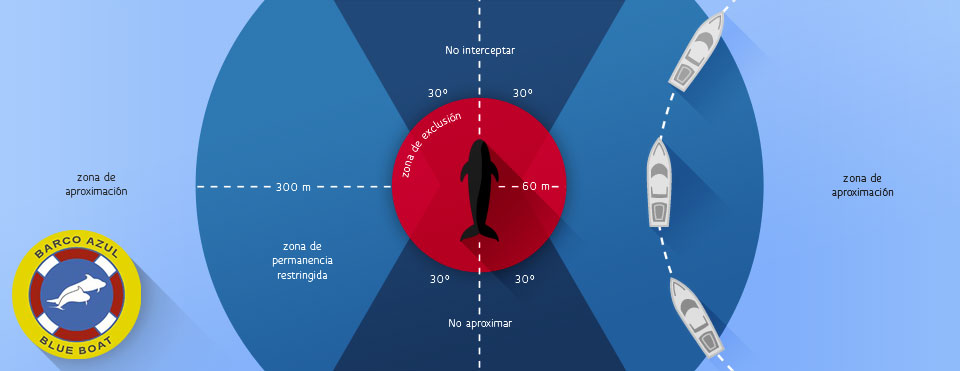
- Never steer a vessel directly towards dolphins or any other marine species. If you are on a boat that you believe is disturbing the animals, politely approach the skipper and suggest changing course to observe them from a different angle, without causing disturbance or putting them at risk. Boats authorised for watching bottlenose dolphins and other cetaceans are identified as Barco Azul (Blue Boat), and must be committed to responsible sighting practices. Some of the requirements to be certified as a Barco Azul include not approaching within 60 metres — which does not prevent the dolphins from choosing to come and bow-ride the vessel — and navigating at reduced speed.
- If they are feeding or showing signs of resting, do not approach, as this may cause them stress.
- If the dolphins abruptly change direction or begin to dive, they most likely want to move away from the vessel: we must leave them in peace. They are very sociable animals — if they want to interact with us, they will.
The southwest coast of Tenerife is considered one of the best areas in Europe for dolphin and whale watching in the wild. We hope that, if you decide to join a Biosean excursion, you enjoy the opportunity to see these incredible animals in complete freedom, following their leaps and bow-riding sprints — but always remember to treat them with the respect they deserve! Bottlenose dolphins represent one of the great jewels of the archipelago’s waters.
Such is their importance that, in the Canary Islands, the European Union has designated several marine protected areas known as “Special Areas of Conservation (SACs)” due to the presence of this and other species, as part of the EU network NATURA 2000.
Biosean: Cetacean Watching and Respect for Marine Wildlife and the Environment
Biosean brings together two very important concepts that may at first seem unrelated: tourism and science. During whale watching trips with tourists, Misael (@misael.morales.vargas), the director and founder of Biosean, is able to collect a large amount of data on the behaviour and sighting frequency of the different cetacean species encountered during trips. In this way, we collaborate with a large number of marine conservation projects, funding science through tourism and through agreements with universities and research institutions.
In addition to boat excursions, at Biosean we offer diving trips guided through the best dive sites in southern Tenerife, as well as internships for biology and marine science students. During their time with us, Biosean interns learn about local marine wildlife, the conservation status of the ZEC Teno-Rasca marine strip and the migratory routes of the different seabirds observed on the island, among many other things.
If you’re looking for an unforgettable cetacean experience, without compromising on sustainability and respect for the sea and these incredible animals… Biosean is waiting for you!