What Do Marine Biologists Do Now That They Are Stranded on Land?
In the midst of the Covid-19 crisis, BIOSEAN suspended all tours and field sampling in compliance with the Spanish government’s lockdown guidelines and for the safety of our guests and team members. We were glad to do our part to prevent the spread of coronavirus and protect the residents of Tenerife, the island we call home. Unfortunately, this means we have not been in the water for these past few months. So — what do marine biologists do now that they are stranded on land? What exactly are we up to?
Photo-Identification
One of our land-based tasks is the continued data analysis for our ongoing research projects, especially our photo-identification work.
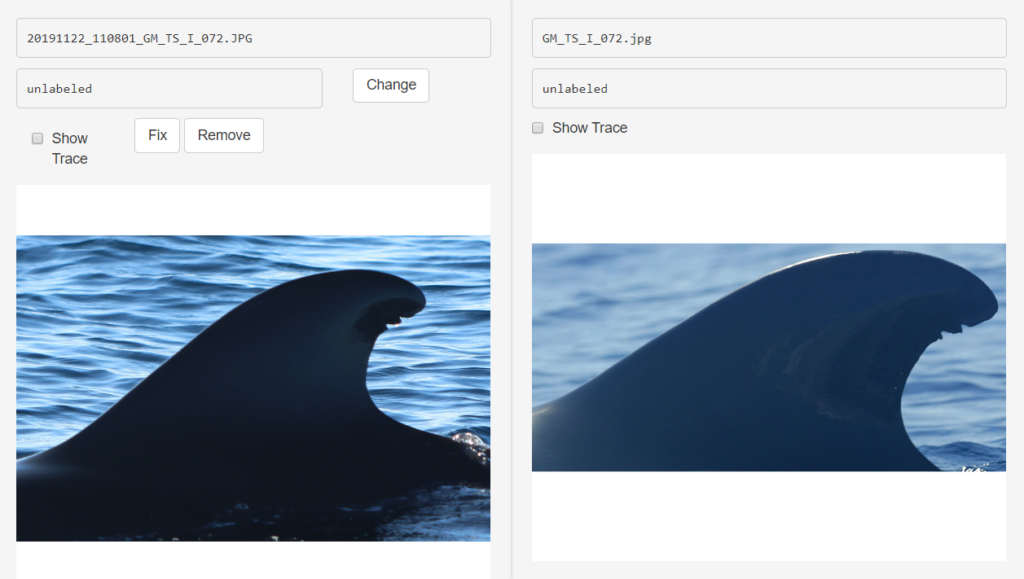
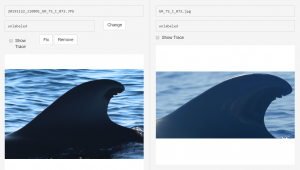
Here you can see some of our dorsal fin identification work! Every dorsal fin is completely unique to each individual short-finned pilot whale, which allows us to track individuals. When we compare the photos we take (on the left) with photos in the catalogue (on the right), we can find out who we have seen during our trips. In these images we have identified Carlos (top) and Pablo (bottom). Photo-identification allows us to learn a great deal about pilot whales, including their movement patterns, breeding intervals, age and family structure!
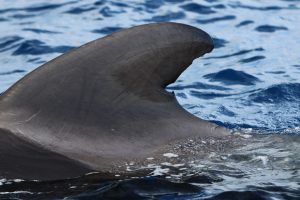 We are also working to identify new whales that have never been photographed before. This work is very important, as identifying more pilot whales helps us provide a more accurate estimate of the population here in Tenerife, and also helps us better understand their social interactions. Here you can see a new whale we have photographed that does not match any individual in the existing catalogue!
What Do Marine Biologists Do Now? Acoustic Analysis
In addition to our photo-identification work, we have also been working intensively on our acoustic analysis. During our field surveys, we collect acoustic recordings of the cetaceans we encounter — the most common being the short-finned pilot whale (Globicephala macrorhynchus). We have been reviewing these recordings to examine the effect of boat noise on the acoustic behaviour of short-finned pilot whales, together with University of Roehampton student Kayla-May Summers, who completed her internship with us during the summer of 2019.
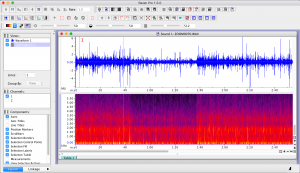
This project is of particular importance in this area of Tenerife, which has a high level of maritime traffic — including whale watching boats, recreational vessels and roll-on/roll-off ferries. Understanding how this acoustic pollution is affecting our marine life is essential if we are to better address the problem. Kayla will be presenting this project next month as her final year dissertation for her undergraduate degree. Good luck, Kayla!
New Collaborations
We are also thrilled to announce a new collaboration we have been working on! We have been selected by Ph.D. candidate Andreia de Sousa from the University of Lisbon to serve as cetacean experts for Macaronesia, as part of a project examining the effects of climate change on the whale watching industry. This project is part of the broader SOCLIMPACT initiative — a European Union-funded project aimed at modelling the effects of climate change at a local scale and their socioeconomic impacts on European islands. We are honoured to contribute to this project and to help drive positive change in the EU and around the world as we help tackle climate change.

While we have thoroughly enjoyed our work on land, we are very excited to get back in the water to collect even more data and new adventures. We can’t wait for you to join us out on the ocean!